The Great Misconception That Costs Players Millions
Walk into any casino or browse online gambling forums, and you’ll hear players throwing around terms like “house edge” and “RTP” as if they’re interchangeable. This fundamental misunderstanding has cost gamblers worldwide an estimated $47 billion in 2026 alone, according to the International Gaming Research Institute. The truth? These mathematical concepts are mirror images of each other, but understanding their subtle differences can transform how you approach every bet.
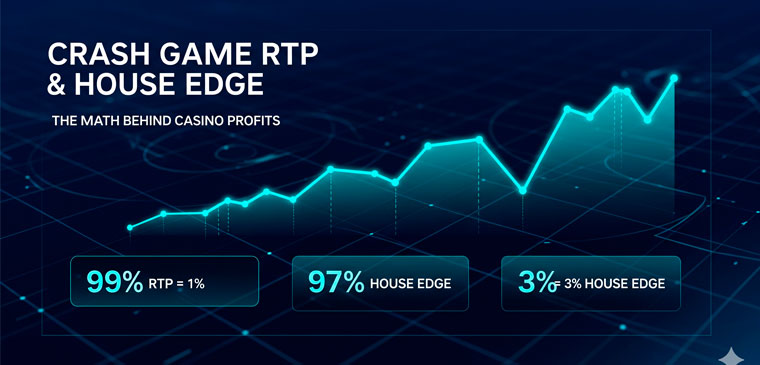
Return to Player (RTP) represents the percentage of wagered money a game returns to players over time, while house edge shows what the casino keeps. If a slot machine has a 96% RTP, the house edge is 4%. Simple math, right? Yet this oversimplification masks crucial nuances that separate winning players from those who consistently lose their bankrolls.
The confusion deepens when we examine how these percentages translate into real money. A game with 97% RTP doesn’t guarantee you’ll lose only $3 for every $100 wagered. Variance, volatility, and session length create dramatic swings that can either multiply your losses or, occasionally, deliver life-changing wins.
Breaking Down the Mathematical Reality
Let’s examine the cold, hard numbers that govern every spin, draw, and card dealt. In 2026, the average RTP across all online casino games sits at 94.7%, according to data from the European Gaming Association. This means the collective house edge hovers around 5.3% – a figure that has remained remarkably stable despite technological advances and increased competition.
But averages tell only part of the story. Lottery games typically offer RTPs between 45-70%, while bingo halls maintain RTPs of 75-85%. Video slots range from 88-98%, with premium games at platforms like National Casino often featuring RTPs above 96%. These variations aren’t arbitrary – they reflect the fundamental economics of different gambling formats.
Consider this practical example: A €100 session on a 94% RTP slot doesn’t mean you’ll walk away with €94. The RTP calculation assumes infinite play over millions of spins. In your 200-spin session, you might lose €50 or win €300. The house edge only manifests its true power across thousands of players and extended timeframes.
The Variance Factor That Changes Everything
Here’s where most players’ understanding completely breaks down. Two games with identical 95% RTPs can deliver vastly different experiences based on their variance profiles. High-variance games might pay out 95% over time, but they’ll take you on a rollercoaster ride of massive losses punctuated by occasional huge wins.
Dr. Sarah Chen, Senior Statistician at the Global Gaming Analytics Consortium, explains: “Players focus obsessively on RTP while ignoring variance, which is like judging a car solely by its top speed while ignoring acceleration, braking, and fuel efficiency. Variance determines your actual playing experience, not the theoretical RTP.”
Low-variance games with 95% RTP might see you lose steadily but slowly, dropping €1-3 per hour during typical sessions. High-variance 95% RTP games could devour your entire bankroll in minutes or deliver a 1000x win that funds months of entertainment. The mathematics remain identical, but the emotional and financial impact couldn’t be more different.
This principle applies equally to lottery and bingo games. Progressive jackpot lotteries exhibit extreme variance – most players lose their ticket price, while a tiny percentage win life-altering sums. The RTP might be 50%, but the variance creates a completely different risk-reward profile than a 50% RTP scratch card game.
Industry Secrets: How Casinos Manipulate Perception
The gambling industry has mastered the art of using RTP and house edge figures to create misleading impressions. Marketing departments prominently display “98% RTP!” while burying crucial details about game mechanics, bonus features, and payout structures in fine print.
Take progressive jackpot slots, for instance. A game might advertise 96% RTP, but 2-3% of that figure comes from the progressive jackpot that 99.999% of players will never win. The base game RTP – what you’ll actually experience – might be only 93-94%. This sleight of hand is perfectly legal but ethically questionable.
Similarly, bonus features can dramatically skew RTP calculations. A slot might achieve its advertised 97% RTP only when players trigger free spins or bonus rounds. If you’re unlucky enough to play 500 spins without hitting these features, your actual RTP could be 85-90%. The advertised figure becomes meaningless for your individual session.
Marcus Rodriguez, former casino floor manager turned gambling consultant, reveals: “We trained staff to emphasize RTP percentages because they sound more favorable than house edge figures. Telling a player about 96% RTP sounds much better than explaining a 4% house edge, even though they’re mathematically identical.”
The Compound Effect: How Time Amplifies Mathematical Disadvantage
Understanding how house edge compounds over time reveals why professional gamblers focus on minimizing exposure rather than chasing high RTP games. A 3% house edge might seem negligible, but its impact grows exponentially with playing time and bet frequency.
Consider a dedicated bingo player who spends €50 weekly across games with an average 80% RTP (20% house edge). Over a year, they’ll wager approximately €2,600. The mathematical expectation suggests they’ll lose €520 – more than 10 weeks of entertainment budget. But variance means their actual results could range from breaking even to losing €1,000 or more.
The compounding effect becomes more pronounced with faster games. Online slot players can easily complete 600-800 spins per hour, compared to 30-40 spins in land-based casinos. This acceleration doesn’t change the RTP, but it dramatically increases the rate at which the house edge extracts value from your bankroll.
Smart players recognize this mathematical reality and adjust their strategies accordingly. Instead of seeking the highest RTP games, they focus on managing session length, bet sizing, and game selection to minimize the compound impact of house edge over time.
Real-World Applications: Making Numbers Work for You
Armed with proper understanding of RTP versus house edge, how do you apply this knowledge practically? The key lies in matching game selection to your gambling objectives and risk tolerance.
For entertainment-focused players, games with moderate RTP (92-95%) but engaging features often provide better value than high-RTP games with boring gameplay. The extra 2-3% RTP won’t significantly impact your €20 entertainment budget, but exciting bonus rounds and graphics enhance your experience.
Serious players pursuing profit should prioritize games with RTPs above 97% and low variance. These combinations offer the best mathematical foundation for extended play, though they require larger bankrolls to weather inevitable losing streaks.
Lottery enthusiasts face a different calculation entirely. With RTPs typically below 70%, traditional lottery games represent pure entertainment rather than investment opportunities. However, understanding the variance profiles of different lottery formats helps optimize your approach. Daily draws with smaller prizes often offer better practical RTPs than massive jackpot games.
The Psychology Behind the Numbers
Why do players consistently misunderstand these fundamental concepts? Psychological research reveals that our brains struggle with probabilistic thinking, especially when emotions and money are involved. The availability heuristic makes recent wins feel more probable than mathematical reality suggests.
This cognitive bias explains why players chase games with recent big payouts, assuming they’re “hot,” despite understanding that each spin is independent. The RTP remains constant, but our perception of probability shifts based on irrelevant information.
Successful gamblers develop what psychologists call “statistical thinking” – the ability to separate short-term results from long-term expectations. They understand that a 96% RTP game will deliver exactly that return over sufficient trials, regardless of recent session outcomes.
The gambling industry exploits these psychological weaknesses through careful game design. Near-miss symbols, celebratory sounds for small wins, and complex bonus structures all serve to obscure the mathematical reality of house edge while maintaining player engagement.
Future Trends: How Technology is Reshaping the Landscape
Blockchain technology and provably fair gaming are beginning to impact how RTP and house edge function in practice. Cryptocurrency casinos can offer real-time RTP verification, allowing players to confirm that advertised percentages match actual payouts.
Artificial intelligence is also changing the game. AI-powered systems can analyze individual player behavior to offer personalized RTP experiences while maintaining overall house edge targets. This technology raises ethical questions about fairness and transparency that the industry is still grappling with.
Virtual reality gambling platforms promise to further complicate RTP calculations by introducing skill-based elements to traditionally luck-based games. As the line between gambling and gaming blurs, traditional RTP metrics may become insufficient for describing player value.
The regulatory landscape is evolving too. Several jurisdictions now require real-time RTP disclosure, forcing operators to display current payout percentages rather than theoretical figures. This transparency helps bridge the gap between mathematical theory and player reality, though adoption remains inconsistent across different markets.